Isles of Scilly Travel Guide: Where to Stay, Eat & Island-Hop
Updated: Sep 25

People often ask me, as someone who runs a travel company, where I go when I want to properly switch off. Not a press trip. Not a familiarisation visit. Just me, my walking shoes, and the need to breathe. The answer, every time, is the Isles of Scilly.
There's something that happens the moment I get off the boat or step off the plane. My shoulders drop. The to-do list in my head goes quiet. And for a few days, the only thing I'm focused on is what's flying overhead, what's on the menu, and which island I want to wander next. If you've been thinking about going — and I know so many of you have mentioned it — then I hope this helps. Because it really does need to be on your list.
So, what actually are the Isles of Scilly?
Just 26 miles off the tip of Cornwall, the Isles of Scilly is an archipelago of around 150 islands, of which five are inhabited: St Mary's, Tresco, St Martin's, Bryher, and St Agnes. It's technically part of England, but it feels like somewhere else entirely. Succulents growing out of dry stone walls, palms growing in gardens and beaches. Crystal-clear water in every shade of turquoise. Beaches with glistening white sand, nobody on them. One main supermarket. No traffic lights or roundabouts. No mass market fast food. No passport required.
It's a bit like stepping back in time — in the best possible way. Things aren't just available in the way you might expect on the mainland. If the supply boat can't get across because the weather's turned, the shelves in the Co-Op might be a little sparse. That's not a warning — it's part of the charm. You quickly realise how much of daily life we take for granted, and how little of it you actually need.
Getting There
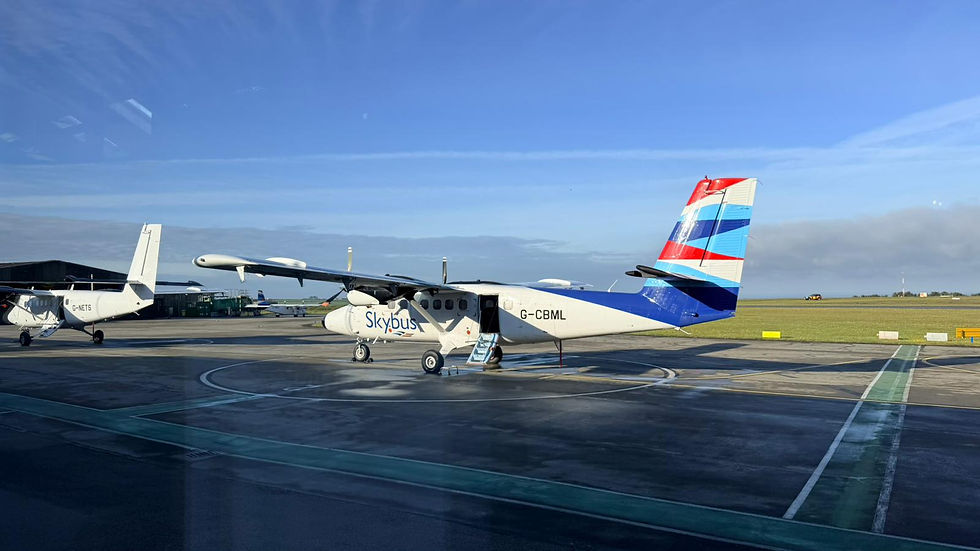
This is the question I get asked most: there are a few options, and they're all a bit of an adventure in themselves.
The Scillonian III ferry sails from Penzance to St Mary's and takes roughly three hours. It's the most affordable option, and the crossing itself is part of the experience — you'll likely spot Gannets, Fulmars, and maybe even Dolphins on the way over. I won't sugarcoat it though: the Scillonian has a reputation, and it's earned. It's a flat-bottomed vessel, and if there's any swell on the water, you'll know about it. Bring travel sickness tablets if you have any tendency towards seasickness, find a seat on one of the open decks at the back and keep your eyes on the horizon or head to the lowest deck and get your head down for a few hours sleep. Its not always tricky, on calm days enjoy the view of the Cornwall coast before you sail out past Lands End and enjoy a journey that goes by in a flash – you never really know what you might see. It runs roughly March to November, Monday to Saturday (and Sundays in peak summer).
Skybus is the light aircraft option, flying from Land's End (about 15 minutes), Newquay (around 30 minutes), or Exeter. It's a small plane — and I mean small — but there's something truly wonderful about that first approach over the islands, watching the water change colour as you descend. The important thing to know: luggage is strictly 15kg per person, and that's enforced. Pack light or pack smart.
The helicopter from Penzance is my personal favourite. It takes about 15 minutes, it flies direct to Tresco as well as St Mary's, and the aerial views are just spectacular. If you're heading to Tresco especially, it's absolutely the way to go. A 20kg of luggage allowance, enables you to take a few more things for your stay.
One thing to bear in mind with all of these: if the weather turns, your plans can change. Fog cancels flights. A rough sea can mean the ferry doesn't sail. It's not a reason not to go — it's a reason to build a little flexibility into your return dates, and maybe not book your last flight home for the morning after you're due back on the mainland.

Which Island — and Where to Stay
If it's your first visit, I'd suggest basing yourself on St Mary's. It's the main island, home to Hugh Town (the closest thing to a town centre you'll find), and the hub for the inter-island boats that'll take you everywhere else. From St Mary's, you can explore all the others as day trips — the St Mary's Boatmen post their daily sailing times on Facebook each morning, and the schedule changes with the tides.
Here's a very quick guide to each island's character:
St Mary's — the hub; most accommodation, restaurants, and facilities; great walking and swimming; perfect for a first visit
Tresco — a privately managed island with the extraordinary Abbey Gardens; more upscale; beautiful beaches; direct helicopter from Penzance
St Martin's — home to some of the best beaches in the UK, a vineyard, a distillery, and seals
Bryher — tiny, wild, rugged, and perfect for those who really want to get away from everything
St Agnes — the most south-westerly; bohemian and arty; home to England's most southerly pub, the Turk's Head
For accommodation, most visitors opt for self-catering — there are lovely cottages and apartments across all the islands, and that independence suits the pace of life out there brilliantly. But there are also some really lovely hotels, and I can talk you through all of them personally because I know most of them first-hand:
Hell Bay Hotel, Bryher — one of the very best; stunning setting, beautiful rooms, and the Crab Shack on site. And if you go, please try the Hell Bay gin. It’s a collaboration with Tarquin’s, made with locally foraged island botanicals, and it’s one of my favourite gins ever. Not sponsored (I wish!) — I just think it’s fantastic.
Star Castle Hotel, St Mary's — a 16th-century hilltop castle with panoramic views; utterly unique
Karma St Martin's — lovely beachside location; dog-friendly; the sunsets from there are something special
Tregarthen's Hotel, St Mary's — sea views, great breakfast, very well-run
The Bell Rock, St Mary's — boutique, beautifully done; really charming
New Inn, Tresco — good pub with rooms; Cornish ales and a genuinely lovely atmosphere
Atlantic Hotel, St Mary's and St Mary's Hall are also solid options depending on what you're after
And if you really want to get back to nature, there's glamping on several islands too
Whether you prefer to be wined and dined and looked after, or whether you'd rather have the independence of your own kitchen and your own schedule — everything is possible. And because I know all of these properties myself, I'm more than happy to help you work out which option is right for you.

Birdwatching on Scilly — A World of Its Own
Right, this is the bit I could talk about forever. If you know me at all, you'll know that birdwatching is my biggest passion — and the Isles of Scilly is, quite simply, one of the greatest places to do it right on your doorstep.
I'm not just saying that. The islands have recorded over 454 species — more than any other single site in Europe. The reason is geography: the Scillies are the first landmass you hit coming in from the Atlantic, meaning they're the natural arrival point for birds that have crossed thousands of miles of open ocean. Standing on the western edge of St Agnes, there is no more land between you and the United States. When the wind and weather systems align just right, birds that have no business being anywhere near Britain simply turn up — and the Scillies are very often where they land.

Autumn — October in particular — is peak season for birders, and it's when I love going most. The variety is extraordinary. On a good day in October, you might find birds from three continents in a single morning: a Yellow-browed Warbler from Siberia in the hedgerows, a Red-breasted Flycatcher from Eastern Europe perched in a garden, and an American vagrant — a Red-eyed Vireo, Blackburnian Warbler or a Rose-breasted Grosbeak — blown clean across the Atlantic by a weather system. It never gets old. Every day is completely different, and every corner you turn holds the possibility of something extraordinary.
Some of the autumn regulars include Wryneck, Bluethroat, Common Rosefinch, Ortolan Bunting, Pectoral Sandpiper, and Black Redstart. More extreme vagrants recorded over the years include Yellow-billed Cuckoo, Scarlet Tanager, Blackpoll Warbler, Cedar Waxwing, White-rumped Sandpiper, and — one of my personal dreams to see — a Belted Kingfisher. People come from all over the world for October on Scilly, and you understand why within about five minutes of arriving.
Spring is brilliant too — and often overlooked. April and May bring overshooting migrants from southern Europe: Hoopoes, Woodchat Shrikes, rare Herons, Subalpine Warblers, and the occasional extraordinary find. The islands are quieter, the wildflowers are spectacular, and there's something wonderfully optimistic about spring birding — everything heading north, full of energy, occasionally landing somewhere it absolutely shouldn't be and delighting everyone who finds it.

For seabirds, the summer pelagic trips off St Mary's are incredible. Puffins breed on Annet (one of the uninhabited islands), alongside Guillemots, Razorbills, Shags, Kittiwakes, and the extraordinary Storm Petrel. The ferry crossing itself is worth doing for the seabirds alone — Gannets, Fulmars, and a chance of Balearic Shearwater on a calm summer crossing.
The practical bit: you don't need to be an expert, and you don't need specialist equipment beyond a decent pair of binoculars. The islands are small and largely walkable, and the bird community on Scilly is wonderfully welcoming. Most birders check the inter-island boats in the morning and follow the news — if something rare has turned up on Bryher, you jump on the boat. That spontaneity is half the fun.
The phone signal is patchy and the wifi unreliable — which, if you ask me, is a feature rather than a bug. It means you're actually looking rather than scrolling. And on Scilly, looking is always rewarded.
Things to Do (Beyond the Birds)
Even if wildlife isn't your thing — though I'd gently suggest Scilly might change your mind — there's so much to do.

Tresco Abbey Gardens is non-negotiable. Over 20,000 plants from 80 countries, thriving in Scilly's extraordinary microclimate — palms, succulents, giant tree ferns, exotic flowers that have no right surviving this far north. It's open daily and adults pay from £18. Set aside a good few hours.
Snorkelling with seals off St Martin's is one of the most wonderful experiences I've ever had in the British Isles. Small group, sustainable, book well in advance because it fills up fast.
The distilleries and vineyards are brilliant — four producers across the islands, including St Martin's Vineyard, Westward Farm Scilly Gin on St Agnes, and Scilly Spirit on St Mary's. The gin school on St Mary's is a really fun afternoon.
Walking is how you really get to know the islands. The Garrison Walls on St Mary's, the wild coastal paths on Bryher, the stroll across to Gugh from St Agnes at low tide — it's all stunning, it's all free, and it all takes you somewhere beautiful.
Gig racing — if you're there in season, make sure you get down to the quay for the traditional pilot gig races. Six-oared wooden boats, local crews from each island racing against each other, watched from the harbour. Every May bank holiday it hosts the Gig World Championships, quite a sight to behold - It's authentically Scillonian and so exciting.

Where to Eat
The food on Scilly is much better than you might expect from somewhere this remote, and it leans heavily on brilliant local produce — seafood especially.
A few places I'd particularly recommend:
Juliet's Garden, St Mary's — spectacular views, lovely food, a proper treat
The Beach, St Mary's — grilled lobster, mussels, sunset views. Brilliant
Dibble and Grub — a gorgeous tapas restaurant in town, with a brilliant takeaway hut next door if you fancy eating on the beach
Poms Kitchen Thai Restaurant and popup — Main restaurant is situated in Old Town with the pop up in the middle of Hugh Town; don't let the word "popup" fool you, it's excellent
Lollipops, the jacket potato pop up — sounds too simple to mention but sometimes it's just the right thing after a long morning's walk
Ruin Beach Café, Tresco — stone-baked pizzas on a wooden terrace by the beach
New Inn, Tresco — great pub food, Cornish beer, good atmosphere and perfect to enjoy after a long days walking on the island before you catch the ferry back to St Marys
Hell Bay Crab Shack, Bryher — one of the best food experiences on the islands, full stop
Turk's Head, St Agnes — England's most south-westerly pub; take the supper boat from St Mary's in the evening
Seven Stones Inn, St Martin's and Polreath Tea Rooms — both lovely for a quieter island lunch
Star Castle Conservatory Restaurant — genuinely one of the best places on St Mary’s to celebrate a special occasion
One important note: some places close in the quieter months, and hours can be limited. It's worth checking ahead — I always know what's open and when, and that's just one of the things I can help with when I'm planning a trip for you.

When to Go
This depends on what you're after, and there's really no bad answer, just different experiences.
April and May are wonderful — quieter, more affordable, the wildflowers are extraordinary, and spring migration means the birding can be spectacular. It can be shorts and t-shirt weather, or it can be brisk and breezy. Pack for both.
June is my sweet spot for a non-birding trip — more reliable sunshine, the Abbey Gardens at their best, before the school holidays push up prices and crowd the boats.
July and August are the warmest months and the busiest, but the islands are big enough that you can still find a beach to yourself.
September and October are when the birding is at its absolute peak, and autumn on Scilly is something special — dramatic skies, the last of the longer evenings, and the thrill of not knowing what might turn up tomorrow.
Winter is quiet and beautiful, though the ferry doesn't run and most businesses close. For those who like the idea of real solitude, it has its own appeal.
A Few Practical Things Worth Knowing
Bring cash. There's one ATM on St Mary's (in Hugh Town), and some of the smaller stalls and honesty shops on the outer islands are cash only
Pack layers. Even in summer, the sea wind is real. A lightweight waterproof is essential
Comfortable walking shoes — not optional
Luggage limits — strictly 15kg on Skybus, so think carefully if you're flying
Seasickness tablets if you're taking the Scillonian — medication from any pharmacy is worth taking in your pocket
Book ahead — accommodation in Scilly is booked from year to year by the same people in the same location, so be quick to snap up what is left around 11 months before you want to travel. Accommodation goes quickly for peak season school holidays and in October as the islands are full of hopeful birdwatchers. As far as things to do, seal snorkelling fills up weeks in advance and popular restaurants get busy in season;
Check the weather before your return — and ideally have a Plan B. The islands have a habit of keeping you a little longer than planned, and honestly, there are worse things
No passport needed — a driving license is absolutely fine if you're flying
Would It Be Right for You?
I get asked this all the time. My honest answer: if you love Cornwall, or the ruggedness of Scotland, or the idea of a proper escape from the noise of everyday life — then yes, almost certainly.
It's not a place for everyone. There are no nightclubs, no big shopping centres, no bucket-and-spade theme park beach experience. What it is is one of the most beautiful, peaceful, restorative places I've ever been. Couples who want proper quality time, families who want something different, solo travellers, wildlife lovers, walkers — it works for all of them, just in different ways.
What I would say is that it rewards good planning. Knowing which island suits you, which accommodation is right for your group, how to get there, what's open when — all of that makes a real difference to how much you get out of it. And that's exactly where I come in.
I've been so many times that I pretty much know every accommodation, every crossing, every island on a first-name basis. If you'd like to talk through what a Scilly trip might look like for you, just drop me a message. It would be my absolute pleasure. 💛
Claire Xx